
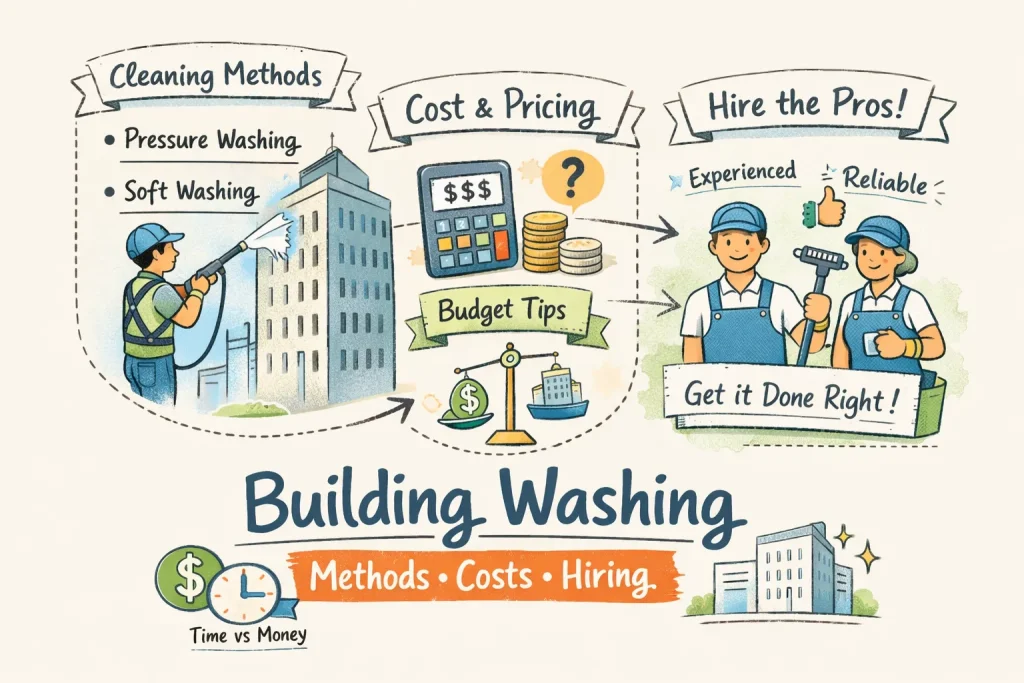
Dirty exteriors are a slow drain on value: clogged gutters, stained façades, and fouled solar arrays cost time, money and tenant goodwill. Over 12 years serving the Bay Area, our woman‑owned team at California Glass & Solar has learned that the right method, the right equipment and a clear contract prevent damage and save money. Read this as a practical field guide—methods, realistic budgets, surface cautions and a hiring checklist so you can hire with confidence.
What building exterior cleaning covers — and why it matters
“Building washing” bundles several related services: façade and storefront cleaning, professional window washing, gutter clearing, roof soft‑washing, dumpster pad sanitizing, parking and hardscape cleaning, and solar array maintenance. Together these keep a property market‑ready, structurally sound, and safe for occupants.
The business benefits are straightforward. First, curb appeal and marketing: a clean exterior attracts tenants and buyers. Second, prevention: organic growth, blocked drains and heavy soiling accelerate material failure and water intrusion. Third, operations and safety: clean walkways reduce slip hazards and clean solar panels preserve generation and ROI.
Call a pro for multi‑story work, graffiti, heavy grease or sensitive claddings (EIFS, historic finishes, architectural metals). DIY can seem cheaper until a wrong nozzle, excessive pressure or the wrong chemical creates a repair bill well above the cost of a qualified crew.
Common job types and outcomes: a storefront refresh improves foot traffic and lease visibility; a multi‑tenant façade clean evens curb appeal and reduces long‑term repainting costs; post‑construction cleans remove grout haze and silicone; grease and graffiti remediation restore public safety and brand image. Bay Area moisture means mildew and algae are common—solar arrays here benefit from purified/deionized water cleaning to protect output.
How methods differ — soft wash, pressure washing and power washing
Choose a method based on surface tolerance, soil type and access. Soft wash uses low pressure plus chemistry to dissolve organic growth. Pressure washing uses higher pressure to blast away dirt. Power washing adds heat to tackle grease and heavy industrial soils.
| Method | Typical PSI | Typical GPM | When to use |
|---|---|---|---|
| Soft wash | <500 PSI | 1–4 GPM | Roofs, stucco, EIFS, painted wood, and organic biofilm |
| Pressure wash | 1,500–4,000 PSI | 3–5 GPM | Concrete, brick, heavy dirt on durable surfaces |
| Power wash (hot) | 1,500–4,400+ PSI | 3–6 GPM | Grease, oil, industrial stains on hard surfaces |
Cleaning power is the product of pressure and flow—Cleaning Units (CU = PSI × GPM). Higher CU can mean faster results, but higher PSI alone increases risk on delicate materials. For a clear explanation of how PSI and GPM interact and why both matter when sizing equipment, see this guide to PSI vs GPM.
One‑sentence surface rules
Concrete and brick: pressure or hot power wash for deep stains. Stucco, EIFS, painted wood and most roofs: soft wash only. Metal: pressure is acceptable but verify factory coatings first. Glass and solar panels: purified/deionized water and soft brushes—no high pressure.
Chemical families in plain language: alkaline degreasers break oils and need heat for best effect; bleach or quaternary ammonium salts treat mold and mildew in soft‑wash mixes; acids remove rust but require neutralization and care. Always ask for SDS sheets and biodegradable options when possible. For a straightforward comparison of soft‑washing vs pressure‑washing approaches and when each is appropriate, this soft‑wash vs pressure‑wash overview is a useful quick read.
Budgeting — what you’ll actually pay
Expect broad industry ranges: simple commercial cleaning typically runs $0.10–$0.35 per sq ft; intensive work (graffiti, grease, heavy remediation) $0.40–$1.00 per sq ft; building exteriors commonly fall between $0.15–$0.90 per sq ft. Flat fees for small jobs often start near $200; complex plazas or multi‑story jobs can be $600–$3,000+ or more. Hourly commercial teams often bill $200–$500/hr for specialized work. For recent regional pricing benchmarks on commercial pressure washing, consult this commercial pressure washing prices guide.
Three short examples to form a quick budget:
Small storefront: 1,500 sq ft at $0.25/sq ft = $375.
Mid‑size office façade: 5,000 sq ft at $0.45/sq ft ≈ $2,250 (adds for lifts/scaffolding).
Large plaza: 15,000 sq ft at $0.20/sq ft = $3,000 (flat fee alternatives possible).
Factors that push price up: height and access (lifts/scaffolding), graffiti or chemical remediation, grease/oil removal, wastewater reclamation and permits, traffic control, required testing, and special tooling such as deionized water rigs or custom soft brushes. Always request an itemized quote, a written allowance for a test patch, and at least three bids for comparison.
Common damages, liability risks and how pros prevent them
Typical damages from improper cleaning include concrete etching, paint stripping, siding warping, water intrusion behind cladding, roof shingle damage and window etching. Causes are usually excessive PSI, incorrect nozzles, hot water on delicate coatings, or the wrong chemistry applied without testing.
Qualified professionals prevent these problems by starting at low pressure and test‑patching, choosing soft‑wash chemistry for vulnerable surfaces, adjusting nozzle angle for broader coverage, using deionized water on glass and solar arrays, protecting landscaping, and staging rinses and neutralizers. They document pre‑work conditions and restore disturbed areas after completion.
Safety and environmental best practices include fall protection and harnesses for heights, traffic control for public access, available SDS sheets on site, and wastewater containment and reclamation. In California the Bay Area enforces strict rules against discharging contaminated rinse water to storm drains—containment and legal disposal are standard on commercial jobs; see an example pressure‑washing guidance and wastewater policy PDF for the sort of local rules crews are expected to follow.
Insurance note: require general liability and workers’ compensation. Typical commercial clients ask for at least $1M per occurrence (often $2M aggregate) and commercial auto if vehicles are onsite. Request a Certificate of Insurance (COI) naming your organization as additional insured for contract work.
Hiring checklist — questions, documents and red flags
- Must‑see documents: business license; Certificate of Insurance (general liability commonly $1M+); workers’ compensation; commercial auto (if vehicles used); SDS for chemicals to be applied; references and before/after photos.
- Questions to ask on the call or site visit: What method do you recommend for this surface? What PSI/GPM and which chemicals will you use? Will you perform a test patch and can I approve it? Who will be on site and what safety training/certifications do they have? How will you handle wastewater and permits? Can you provide a firm, itemized written quote and timeline?
- Contract essentials: clear scope with exclusions, schedule and access needs, traffic control and cleanup responsibilities, payment terms, warranty or damage remedy clause and agreement on test‑patch acceptance criteria.
- Red flags: pressure‑only answers for every surface; refusal to provide a COI or to add you as additional insured; vague pricing or “estimate only” without line items; refusal to conduct a test patch; no references or portfolio.
- Local exemplar — California Glass & Solar: we provide free on‑site estimates and test patches, purified‑water solar cleaning with soft brushes, custom in‑house tools for local materials, COI on request, and Bay Area references. Use our process as a checklist model when vetting any contractor.
Aftercare, maintenance cadence and next steps
Service intervals depend on exposure. High‑moisture or coastal façades typically need attention every 6–12 months. Urban commercial façades usually fall in a 12–36 month band. Grease‑heavy or industrial sites require much more frequent cleaning—quarterly to semi‑annual.
Bundling services—façade, windows and solar cleaning—reduces mobilization costs and protects asset value. Clean solar arrays produce more energy, so routine cleaning can pay back in kilowatt‑hours over time.
On an on‑site estimate you should expect a walkthrough, discussion of method options, a test patch, and an itemized written quote with access, timeline and warranty language. If you want a local, eco‑minded partner that follows this checklist, request a free on‑site estimate and test patch from California Glass & Solar; we’ll show method options, demonstrate tools and provide an itemized quote so you can compare apples to apples.
Two brief takeaways: pick the cleaning method to match the surface—soft wash for delicate cladding, pressure/power for hardscapes—and always vet contractors for insurance, SDS, test patches and itemized quotes. When those boxes are checked, you protect value and avoid costly repairs.
If you’d like a free, on‑site estimate and a no‑surprise test patch in the Bay Area, contact California Glass & Solar; we’ll show the methods we recommend, the tools we build in‑house, and the itemized quote you need to hire with confidence.